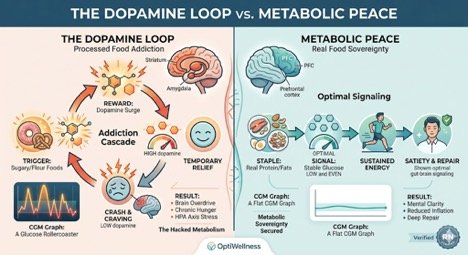
The RN Insight: Food addiction is not a character flaw; it is a physiological response to hyper-palatable “industrial” substances. When the dopamine receptors in your brain are overstimulated by sugar and flour, your prefrontal cortex (the decision-maker) goes offline. This protocol is designed to “quiet the brain” so your metabolism can finally heal.
Before we can treat the biology, we must identify the trigger. Following the Modified Yale Food Addiction Scale, we look for:
Dr. Jen Unwin emphasizes the “abstinence model” for specific triggers. For many, moderation is a biological impossibility until the brain is reset.
The Transition: Expect the “Withdrawal Window” (3–5 days). Symptoms like headaches or irritability are signs of the brain recalibrating its dopamine baseline.
We do not focus on restriction; we focus on Nutrient Density.
The Fiber Shield: Using 7–10 cups of leafy greens daily to provide the volume stretch-receptors in the stomach need to signal fullness to the brain.
Addiction thrives on stress. Before any “slip,” apply the clinical HALT check:
1/2 tsp high-quality sea salt in water.
Often, “sugar cravings” are actually a signal of electrolyte depletion during a metabolic shift.
Use a timer when a craving hits.
Craving “waves” usually peak and dissipate within 15 minutes if not fed.
4s In, 4s Hold, 4s Out, 4s Hold.
Manually shifts the brain from the “addiction-driven” amygdala to the “logic-driven” prefrontal cortex.
The Fork in the Road
Abstinence from sugar/flour leads to a significant reduction in depression and anxiety scores.
Processed Food Addiction
Treating processed food as a “Substance Use Disorder” is necessary for long-term metabolic success.
University of Bordeaux
Sugar has been shown in animal studies to be more addictive than cocaine due to its rapid dopamine release.
“Silence the noise to hear your body.”
Recovery from food addiction is the ultimate act of self-care. When you remove the substances that hijack your brain, you aren’t just losing weight; you are regaining your Metabolic Sovereignty.
We use necessary cookies to make our website work, including account, shopping, security, and payment functions. With your permission, we may also use cookies or similar technologies to display third-party content such as videos. You can accept or manage your preferences at any time.
Explore the foundational areas that support whole-person wellness.
Many chronic conditions share common metabolic and lifestyle influences. Select a topic to explore evidence-informed education and practical wellness considerations.
Explore glucose regulation, insulin function, weight, and metabolic health.
Learn about blood pressure, cholesterol patterns, and vascular health.
Explore liver health, hormone balance, and related metabolic signals.
Understand how stress, inflammation, and neurologic health may interact.
Explore digestive, oral, and broader whole-body wellness connections.
Get personalized guidance to improve your metabolic health.
Choose your preferred date and time below.